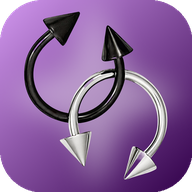
18g captive bead ring (the standard)
A small implant-grade titanium or niobium CBR with a modest bead — light enough for the frenulum, with the classic peek-a-boo flash when you grin.
The smiley pierces the thin web of tissue connecting your upper lip to your gum — invisible at rest, flashing a small ring only when you grin. It is one of the most charming piercings in the catalog, and one where you genuinely need the honest version before you book.
Reviewed and updated 2026-07-22
Lift your upper lip in a mirror and you will see a thin vertical band of tissue tethering it to your gum — the upper labial frenulum. A smiley piercing passes a small ring through that web, so the jewelry hangs hidden behind your lip and peeks out only when you smile widely. Hence the name.
This is one of the most anatomy-dependent piercings there is. Frenulums vary enormously: some are substantial enough to hold a ring comfortably, many are so thin the piercing would tear through or migrate out within months. A reputable piercer looks first and declines a good share of smiley requests — treat a no as professional honesty, not gatekeeping.
It is also worth knowing going in: even well-placed smileys are often not forever piercings. The frenulum is fragile tissue, and many wearers retire the ring after a few years by choice or migration. The good news — a retired smiley leaves no visible scar.
The smiley sits around 5 out of 10 — sharper than its tiny size suggests, because the frenulum is thin, sensitive tissue, but genuinely brief. The pinch is over in a second, with a sting that fades within minutes.
The aftermath is milder than lip piercings: modest swelling, a day or two of tenderness when you stretch your lip, and a strange awareness of the ring during the first week of talking and eating. Most people call it one of the easier piercings they have had done.
This is the section that matters most. A smiley ring rests millimeters from your front teeth and upper gumline, and every word you speak moves it slightly against them. Over months and years, that contact can wear enamel on the front teeth and contribute to gum recession above them — dentists can usually spot a long-term smiley wearer.
You reduce the risk with size and discipline: the smallest, lightest ring your anatomy allows, smooth beads rather than textured or oversized ends, no playing with the ring against your teeth, and regular dental check-ups where you ask specifically about the contact points. Many wearers treat the smiley as a some-years piercing rather than a decades one for exactly this reason.
If you have braces, enamel issues, or existing gum recession, this is a piercing to skip — the ring adds friction exactly where you can least afford it.
Smileys heal fast — 4 to 12 weeks, among the quickest piercings anywhere, because oral tissue regenerates rapidly. Care is simple: alcohol-free antiseptic or saline rinses after eating and before bed, gentle brushing near the frenulum, and skipping spicy food, alcohol, and smoking for the first couple of weeks.
Fast healing does not mean invulnerable: the frenulum stays thin forever, and aggressive brushing, hard foods caught in the ring, or fiddling can migrate the piercing even after it has settled. Treat it gently for life, not just for the healing window.
Small and light wins here — the frenulum can only hold so much, and everything you wear rests near your teeth.
A small implant-grade titanium or niobium CBR with a modest bead — light enough for the frenulum, with the classic peek-a-boo flash when you grin.
A smooth continuous ring reads cleaner than a bead and has no captive to lose mid-sandwich. Keep the diameter snug so it does not hang against the gumline.
Two small balls framing the frenulum — a slightly bolder flash. Choose compact ends; oversized balls double the tooth-contact surface.
Weight stresses the thin frenulum toward migration, and textured beads act like tiny files against enamel. If a piece feels substantial in your hand, it is wrong for a smiley.
Around 5/10 — a sharp but very brief sting through thin, sensitive tissue. Swelling and aftercare discomfort are milder than lip piercings; most people rank it among their easier piercings overall.
4 to 12 weeks — one of the fastest-healing piercings, thanks to quick-regenerating oral tissue. Rinse with alcohol-free mouthwash or saline after eating, and keep hands and tongue off the ring.
It can over time — the ring sits against your front teeth and gumline, and long-term contact can wear enamel and contribute to gum recession. Small, smooth, light jewelry and regular dental checks reduce the risk; braces or existing gum issues are reasons to skip it.
Typically $30–$70 in the US including the starter ring. The anatomy check is the valuable part of the appointment — pay for a piercer experienced enough to tell you honestly whether your frenulum can hold it.
Better than almost any facial piercing — it is invisible at rest and only shows in a wide grin. For strict environments, a clear or small retainer makes even the smile-flash easy to miss.
Two questions, two checks. Your piercer must confirm your frenulum is thick enough to pierce safely. For the look, previewing that flash-of-a-ring smile on your own photo shows whether the smiley's whole charm — hidden, then there — fits your style.
Piercing Types
"Lip piercing" is a family, not a single spot: labret below the lip, Monroe and Medusa above it, side lip rings, and paired bites. Placement changes the whole look — this guide maps the options so you can pick the one that fits your face.
Piercing Types
The labret sits centered just below your lower lip — a clean, symmetrical face piercing that has moved effortlessly from punk staple to minimalist classic. One word of warning up front: 'labret' names both this piercing and the flat-back stud style worn in half the piercings on this site.
Piercing Types
A tongue piercing is a straight barbell through the midline of the tongue — hidden when you want it to be, unmistakable when you talk or laugh. The needle is the easy part; the swollen, mumbling first week is what nobody warns you about.
Piercing Tools
The chart above lists the real healing window for every piercing. This guide covers what the numbers can't: the biology behind them, the trap that catches almost everyone at month two, and how to read what your piercing is telling you.
Piercing Tools
The chart above ranks every piercing from the 2/10 earlobe to the 8/10 snug. This guide explains where those numbers come from — the tissue science, the psychology, and the things that genuinely move a piercing up or down the scale.
Piercing Quizzes
Six honest questions — pain tolerance, how long you can baby a healing piercing, what your job allows, your style, your budget, and how committed you are — matched against eight realistic first-choice piercings.