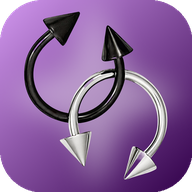
Nostril screw or labret stud (the healing standard)
A tiny gem or ball on a post that either curls inside the nostril (screw) or secures with a flat back (labret). Low-profile, snag-resistant, and what good piercers install on day one.
When people say 'nose piercing' they almost always mean the nostril — a small stud or hoop through the curve of the nostril, and one of the most worn piercings on earth. It is subtle, endlessly customizable, and sits right in the middle of your face, which makes placement the whole game.
Reviewed and updated 2026-07-22
A nostril piercing goes through the soft cartilage of the nostril wall, classically at the crease where the nostril flares — the spot that suits most noses and takes both a stud and a hoop well. Higher placements read more delicate; lower ones let a ring hug the nostril closely.
Left or right is purely personal preference in modern practice — pick the side you photograph better on, the side you don't sleep on, or the side that balances other piercings you already have. There is no rule that means anything anymore.
Because this is nose cartilage, it is needle-only work. A piercing gun on a nostril is both more traumatic and less precise, and precision is everything on a piercing this central to your face. Go to a professional piercer, always.
Most people rate a nostril piercing around 5 out of 10: a sharp, hot pinch that spikes for a second, makes the eye on that side water, and settles into a dull warmth within minutes. It is over before you have finished bracing for it.
The lingering cost is tenderness rather than pain — expect the nostril to be sore to the touch for a few weeks, which mostly matters when you wash your face, dry off with a towel, or catch it while blowing your nose. Colds and hay fever season are genuinely annoying with a fresh nostril piercing; time yours accordingly.
Plan on 2 to 6 months. A nostril heals faster than ear cartilage but slower than a septum, and it is notoriously moody along the way — the little irritation bump that appears at week six is almost a rite of passage. Bumps usually trace back to snags, sleeping on it, or changing jewelry too early, and they settle with patience and saline, not with tea tree oil experiments.
The rules that matter: sterile saline twice a day, no twisting, no swapping jewelry before roughly the four-month mark, and be careful with towels, glasses, and makeup around the area. If you must cover it for work or sport, ask your piercer about a retainer rather than repeatedly removing the jewelry — fresh nostril holes can shrink closed in hours.
Start with an 18g–20g implant-grade titanium stud, then open up the options once you are fully healed.
A tiny gem or ball on a post that either curls inside the nostril (screw) or secures with a flat back (labret). Low-profile, snag-resistant, and what good piercers install on day one.
The classic nose ring. A snug hoop that hugs the nostril looks effortless — but save it for a matured channel, because hoops move more and irritate fresh piercings.
Easy to insert once healed and widely available in every style — good everyday drivers, though bones can be uncomfortable to remove and are best for settled piercings.
A 2mm gold ball reads minimalist; a small opal or diamond reads jewelry-box. Because the nostril is so visible, tiny quality upgrades here are the most noticeable money you can spend.
| Feature | Nostril | Septum |
|---|---|---|
| Placement | Through the side of the nostril | Soft tissue between the nostrils |
| Look | A visible gem or hoop on the nostril curve | A ring hanging centered under the nose |
| Healing time | 2–6 months | 6–12 weeks |
| Hiding it | Hard — a retainer helps but the spot faces forward | Easy — flip-up jewelry disappears completely |
| Pain | Around 5/10 | Around 6/10 with watering eyes |
The piercer marks the crease of your nostril and checks it from every angle — bring your AI preview so you both aim at the same look, side, and height.
A hollow needle passes through the nostril in about a second, jewelry follows immediately, and your eye waters on cue. The dramatic part is over.
Twice-daily saline, no jewelry changes, careful with towels and glasses, and resist picking at the crusties — soak them off instead.
Once settled, the piercer can swap the longer healing post for a snug stud — and around six months you can graduate to that hoop.
Around 5/10: a sharp, eye-watering pinch that lasts a second, then fading warmth. Most people say the anticipation was worse than the needle — the tender weeks afterward are the part that actually tests you.
2 to 6 months for a nostril. It will look fine well before it is actually healed — keep the starter stud in for at least four months, because fresh nostril holes can shrink within hours of removing jewelry.
Typically $30–$80 in the US including basic jewelry. Implant-grade titanium or 14k gold is worth it on a piercing this central to your face — cheap metal shows and irritates in equal measure.
A stud, almost always. Hoops shift with every facial movement and towel pass, which fresh nostril piercings hate. Heal with a nostril screw or labret stud, then switch to a snug hoop once your piercer confirms the channel has matured.
A clear glass or bioplast retainer makes a nostril piercing much less noticeable, but unlike a septum it never fully disappears. If your workplace is strict, get pierced before a stretch of remote days or holidays so the tender no-swap window passes quietly.
Almost every nose can wear one, but side, height, and stud-versus-hoop change the effect a lot. Previewing placements on a photo of your actual face — left, right, high, low, gem, ring — answers the question honestly before you book.
Piercing Types
The septum piercing sits in the thin wall between your nostrils and has gone from counterculture badge to mainstream staple — partly because it heals fast for a nose piercing, and partly because it is the only facial piercing you can genuinely hide in seconds.
Piercing Types
A high nostril piercing sits noticeably above the classic nostril position, up along the nasal bridge side where the nose starts to slope. Worn alone or stacked with a standard nostril stud, it is the editorial, fashion-forward take on the nose piercing.
Piercings by Location
The nose offers six genuinely different piercings, from the everyday nostril stud to the engineering project that is a nasallang. This hub compares them all — pain, healing, visibility, and hideability — so you can find the one that fits your face and your life.
Virtual Try-On
A nose piercing sits in the middle of every photo you'll ever take, so guess wrong and you'll know it daily. PiercingAI renders studs and hoops on your actual nose before the needle decides for you.
Piercing Tools
The chart above ranks every piercing from the 2/10 earlobe to the 8/10 snug. This guide explains where those numbers come from — the tissue science, the psychology, and the things that genuinely move a piercing up or down the scale.
Piercings by Face Shape
Nose jewelry sits at the dead center of your face, which makes it the highest-leverage styling decision in piercing: a few millimeters of diameter change how your whole face reads. Same nostril piercing, different ring — completely different effect per face shape.