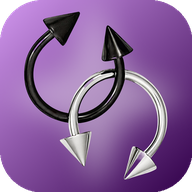
Long labret studs (healing standard)
14g–16g implant-grade titanium labrets with deliberately long posts — your cheeks will swell more than you expect, and a too-short bar can embed.
Cheek piercings — usually done as a symmetric pair where dimples would sit — create one of the most striking facial looks in piercing. They are also one of the highest-commitment piercings you can get, and you deserve the honest version before you book.
Reviewed and updated 2026-07-22
A cheek piercing passes through the full thickness of the cheek, from the outside skin into the mouth, usually placed where a natural dimple would appear when you smile. Most people get them as a matched pair, which is why they are often called dimple piercings.
This is advanced-tier work. The cheek contains the parotid duct — the channel that carries saliva from a major gland into your mouth — and piercing through or near it can cause complications that do not simply heal on their own. A piercer taking this on should palpate and mark your anatomy carefully, and if a shop treats it like a routine lip piercing, that is your cue to leave.
Cheek piercings are always done freehand with a sterile hollow needle by an experienced professional. Between the anatomy involved and the long heal, this is the last piercing to bargain-hunt for.
Here is the honest core of this guide: cheek piercings leave marks for life. When you retire them — and most people eventually do — the holes close into small indented scars that often read as permanent artificial dimples. Some people love that outcome and treat it as the whole point. Others are caught off guard, because no other common piercing changes your face permanently the way this one can.
Even while you wear them, expect visible changes: the tissue around the barbell can dimple, pucker, or leak small amounts of clear fluid during the long healing window. If the idea of a lifelong dimple-scar souvenir bothers you at all, this is not your piercing — and a good piercer will say exactly that in the consult.
Most people rate cheek piercings around 6 out of 10 — the needle passes through a lot of tissue, and doing both sides in one sitting means the second one comes while the first is already throbbing. The first two weeks bring significant swelling that can make chewing and talking genuinely awkward.
Healing takes 6 to 12 months, and cheeks are famously moody healers even by facial-piercing standards. The inside of your mouth constantly bathes the piercing in bacteria and movement: every bite, laugh, and word flexes the channel. Lumps, swelling flare-ups, and irritation cycles months into healing are normal here, not a sign you did something wrong.
Aftercare is double-sided: sterile saline on the outside twice a day, and an alcohol-free rinse after eating for the inside. Skip straws early on, go slow with chewy food, and keep your hands off your face.
Cheek jewelry has one job during healing: give the swelling somewhere to go without drilling the back disc into your gums.
14g–16g implant-grade titanium labrets with deliberately long posts — your cheeks will swell more than you expect, and a too-short bar can embed.
Once the swelling is gone, the piercer swaps to shorter posts so the disc stops rubbing your molars and gums — do not skip this appointment.
A small titanium ball reads classic; a flat gem catches light exactly where a dimple would. Keep fronts low-profile so they do not snag on scarves and helmets.
The inside disc sits against your teeth for years, so material quality matters twice as much here — implant-grade titanium only, no mystery metal.
| Feature | Cheek piercing | Cheek dermal |
|---|---|---|
| Depth | All the way through into the mouth | Sits in the skin only, no oral side |
| Look | Creates a true dimple effect when healed | A flat gem on the cheek surface, no dimpling |
| Risks | Parotid duct, gum and tooth wear, permanent scars | Rejection and migration, small flat scar if removed |
| Commitment | 6–12 month heal, lifelong marks | Often temporary by design, easier retirement |
Around 6/10 — sharper than a lip piercing because the needle travels through much thicker tissue, and the second cheek hurts more because you are already sore. The heavy swelling in week one is what most people remember, not the needle.
Yes, almost always. Retired cheek piercings typically close into small indented scars that look like permanent artificial dimples. Many people get the piercing precisely for that; if you would not want the scars, do not get the piercing.
6 to 12 months, and cheeks are erratic healers — swelling flare-ups and lumps months in are common. Constant mouth movement and saliva exposure make this one of the slowest, fussiest facial piercings to settle.
Expect $60–$140 for the pair with quality titanium jewelry, and prioritize an experienced piercer over price — cheek anatomy (including the parotid duct) is not something to trust to the cheapest shop in town.
The inside discs can rub gums and enamel, especially if the posts stay too long after swelling drops. Downsizing on schedule and wearing implant-grade titanium keeps the risk low, but some contact with your molars is part of the deal.
It depends on your cheek fullness and where your natural smile creases fall. Previewing a symmetric pair on a photo of your own face — smiling and neutral — shows you the effect before you commit to a piercing whose marks are permanent.
Piercing Types
A Medusa piercing — also called a philtrum piercing — sits dead center in the groove above your upper lip. One tiny stud, placed on your face's axis of symmetry, and it becomes the focal point of your whole look. Few piercings change a face this much with this little metal.
Piercing Types
A Monroe piercing is a single stud on the upper lip's left side, placed to mimic Marilyn Monroe's beauty mark. It is one of the most deliberately glamorous facial piercings — a tiny gem that reads like a permanent accent rather than hardware.
Piercing Types
"Lip piercing" is a family, not a single spot: labret below the lip, Monroe and Medusa above it, side lip rings, and paired bites. Placement changes the whole look — this guide maps the options so you can pick the one that fits your face.
Piercing Tools
The chart above lists the real healing window for every piercing. This guide covers what the numbers can't: the biology behind them, the trap that catches almost everyone at month two, and how to read what your piercing is telling you.
Piercing Quizzes
This one isn't about pain charts — it's about taste. Answer five questions about your aesthetic, where you want the attention, your metals, and your day-to-day, and get the piercing look that matches how you actually dress.
Virtual Try-On
No layers, no masks, no tutorials. Pick a photo, pick a piercing, and the AI edits it in with correct lighting and sizing — the result Photoshop skills would take an hour to fake, in seconds.