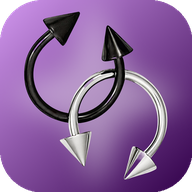
Eyes → eyebrow piercing
A curved barbell on the brow ridge frames the eye directly beneath it. On an oval face there's no widening or lengthening side effect to manage — it's pure eye emphasis.
An oval face — slightly longer than wide, cheekbones the widest point, gently tapering jaw — is the shape every guideline treats as the baseline. Almost nothing works against it, so the real question isn't what you can wear. It's what you want the piercing to do.
Reviewed and updated 2026-07-22
Face-shape advice exists to correct imbalances: add length to a wide face, soften an angular jaw, ground a heavy forehead. An oval face has none of those imbalances — its proportions are already the reference point the other rules aim for. Add a vertical element and it still looks balanced; add a horizontal one and it still looks balanced.
That freedom flips the decision on its head. Instead of asking which piercings suit an oval face (nearly all of them), ask which feature you'd like people to notice first. A piercing is a spotlight — on an oval face, you get to point it anywhere.
Pick the feature, and the placement follows.
A curved barbell on the brow ridge frames the eye directly beneath it. On an oval face there's no widening or lengthening side effect to manage — it's pure eye emphasis.
A small gem at the forward helix or a high-nostril stud sits level with the top of the cheekbone and bounces light exactly where you want the eye to land.
Center-line lip piercings (philtrum above, labret below) draw a frame around the mouth. Paired styles like snake bites add symmetry an oval face carries effortlessly.
This is the shape that can wear the wide-diameter septum ring the guides warn everyone else about. Start with a slim ring or stud, scale up if you want more presence.
Drops that end below the jaw trace its taper. On an oval face this reads elegant rather than corrective — it's decoration, not adjustment.
Eyes, cheekbones, lips, nose, or jaw — pick the one you already like most in photos of yourself. That's where the piercing goes to work.
Subtle (tiny gold stud), noticeable (small hoop or single facial piercing), or statement (septum ring, industrial, paired lip studs). Oval proportions support all three.
For an oval face the real constraints are work dress codes, helmets, headphones, and sleep habits — practical factors matter more than visual ones here.
Try your top two or three candidates on a photo of your own face in the PiercingAI app. Even on the everything-works shape, seeing it beats imagining it.
Because nothing is off-limits, the common failure mode isn't a wrong choice — it's accumulation without a plan. Six piercings each chosen in isolation can crowd each other and blur the balanced proportions you started with. A curated ear plus one facial piercing almost always reads cleaner than jewelry scattered evenly everywhere.
A useful discipline: decide on one focal zone per view. From the front, maybe that's a septum ring; from the side, a conch stud anchoring a small helix stack. When every angle has one clear point of interest instead of three competing ones, the oval face does what it does best — makes everything look intentional.
Even for the most forgiving face shape, real-life details the rules can't see — your hairline, glasses, freckles, how you smile — decide whether a piercing feels like you. Face-shape theory says an oval face can wear a bridge piercing; only a preview on your actual face says whether you'd love it.
That's the point of trying before piercing. Upload a photo, cycle through the candidates from this page, and let your own reaction pick the winner. The needle is permanent-ish; the preview costs nothing.
Nearly all of them — eyebrow, nostril, septum, lip, helix, conch, industrial, and more. Oval proportions are the baseline other face-shape rules aim to create, so instead of avoiding anything, choose based on which feature you want to highlight.
There's no single best — that's the oval advantage. A popular starting point is a small nostril stud or a helix, because both flatter universally and heal predictably. If you want a statement, the septum sits beautifully on oval proportions.
Yes. Wide circular jewelry adds width at mid-face, which is exactly what round faces are told to watch — but an oval face has length to spare, so bigger diameters stay balanced. Start slim and size up to taste.
Hair pulled back, straight-on mirror: an oval face is modestly longer than wide with cheekbones as the widest point and a softly tapering jaw. If width and length are about equal you're round; if the face is dramatically longer than wide, read the long-face guide.
Less than for any other shape — which is freeing but also unhelpful when you're deciding. Use feature-highlighting as your compass instead, and preview finalists on a photo of your own face rather than trusting any rule, including this page's.
Piercings by Face Shape
Piercings don't change your face — they change how it reads. Vertical elements lengthen, horizontal and rounded elements widen and soften, and every gem drags the eye toward itself. Work out your shape below, and the right placements follow almost automatically.
Piercings by Face Shape
A round face reads soft and full because its width and length are nearly equal. Piercings can shift that read: vertical elements pull the eye up and down and visually lengthen, while wide horizontal pieces at cheek level add width you may not want more of.
Piercings by Face Shape
An oval face — slightly longer than wide, with a gently rounded jaw and balanced proportions — is the shape jewelry designers assume by default. That means the question isn't 'what can I wear?' but 'which of everything suits my nose, my features, and my style?'
Piercings by Face Shape
An oval face is the all-access pass of ear curation: no placement widens, shortens, or unbalances anything, so helix stacks, chunky hoops, conch gems, and asymmetric ears are all fair game. The skill worth learning isn't restriction — it's composition.
Piercing Quizzes
Grab a mirror. Five quick questions about your face's length, jawline, and cheekbones identify your face shape — round, oval, square, heart, long, or diamond — and route you to the piercing placements that play to it.
Virtual Try-On
No layers, no masks, no tutorials. Pick a photo, pick a piercing, and the AI edits it in with correct lighting and sizing — the result Photoshop skills would take an hour to fake, in seconds.